
Metal Filters
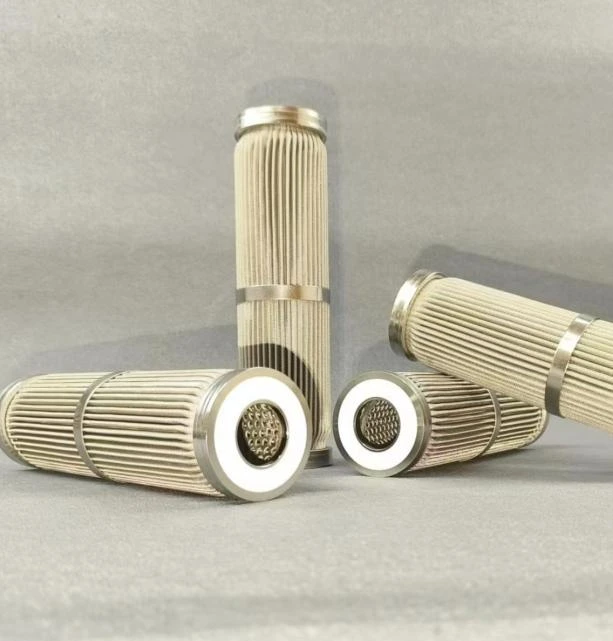
Pleated Metal Cartridges
Select pleated metal media around the corrosive environment, differential pressure and cleaning method.
Stainless steelExplore ↗
FILTRATION / Metal Filters
Assess titanium structures against the actual fluid and filtration conditions. Validate cleaning and reuse in practice.
Images and specifications refer to the indicated models. Contact us to confirm configuration and suitability.
A titanium cartridge commonly uses a sintered titanium-powder wall with interconnected passages for particle separation. Suitability depends on titanium’s behaviour in the particular corrosion environment, not a universal claim of acid or alkali resistance. Internal deposits, end connections and seals also affect service. Applications involving repeated cleaning need a defined regeneration endpoint and a way to reassess performance.
| Selection factor | What to compare |
|---|---|
| Corrosion conditions | Chemical identity, impurities, temperature and concentration jointly determine suitability. |
| Pore grade | Sintered passages are not ideal uniform screen openings; interpret ratings with retention tests. |
| Interface and seals | Threaded, plug-in and compression formats need matching housings and compatible sealing materials. |
| Category | Metal Filters |
|---|---|
| Material options | Titanium |
| Filtration objective | Define what to remove and what to retain |
| Rating / Dimensions | Confirm combinations against controlled model specifications |
| Flow / Temperature / Pressure | Specify normal and limiting operating conditions |
| Connections / Seals | Confirm installation interfaces and wetted materials |
| Cleaning / Validation | Confirm the service cycle and acceptance criteria |
These are selection inputs, not verified performance claims for a specific model.
Use the worksheet to collect your operating conditions. Contact us for controlled datasheets, dimensional drawings or validation documents for a specific model.
Product selection worksheet · TXT ↓Request technical documents ↗Complete appropriate preparation and rinsing, establishing background and flow baselines.
Monitor pressure and downstream particles while avoiding shocks to connections or porous walls.
Reassess cleanliness, structure and filtration rather than simply confirming liquid passage.
Corrosion behaviour, construction and cost differ and require duty-specific assessment.
Deposits, cleaning and material condition jointly determine life, so a universal cycle count is inappropriate.
RELATED PRODUCTS
Select pleated metal media around the corrosive environment, differential pressure and cleaning method.
Confirm alloy, pore structure and complete-assembly conditions for sintered filtration media.