
Metal Filters
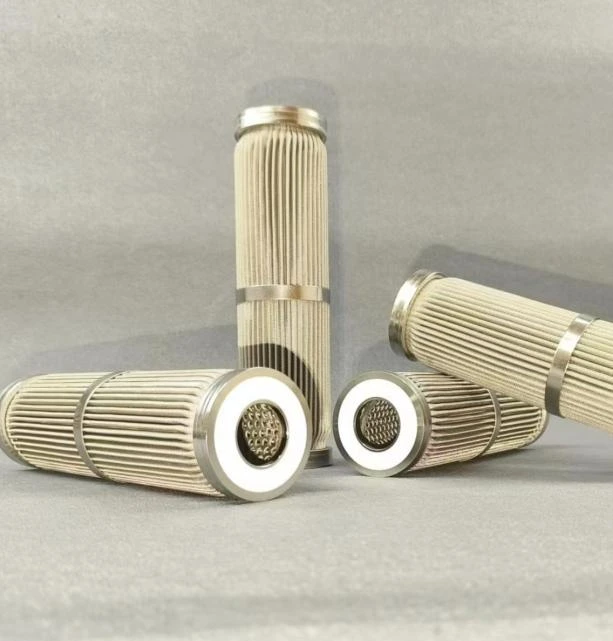
Pleated Metal Cartridges
Select pleated metal media around the corrosive environment, differential pressure and cleaning method.
Stainless steelExplore ↗
FILTRATION / Metal Filters
Confirm alloy, pore structure and complete-assembly conditions for sintered filtration media.
Images and specifications refer to the indicated models. Contact us to confirm configuration and suitability.
A sintered-metal cartridge forms interconnected passages by bonding particles or mesh layers. Fluid passes through the porous wall while particles accumulate on its surface and within its depth. Different pore structures and wall thicknesses provide different flow and cleaning behaviour. Cleanability depends on releasing deposits from those passages, not simply on using metal, so filtration and regeneration should be planned together.
| Selection factor | What to compare |
|---|---|
| Sintered form | Powder and multilayer-mesh structures have different passages, surfaces and cleaning access. |
| Alloy and corrosion | Actual impurities, concentration and temperature can affect local corrosion and pore stability. |
| Thickness and area | Thicker walls trade resistance and cleaning access against mechanical requirements. |
| Category | Metal Filters |
|---|---|
| Material options | Alloy-specific |
| Filtration objective | Define what to remove and what to retain |
| Rating / Dimensions | Confirm combinations against controlled model specifications |
| Flow / Temperature / Pressure | Specify normal and limiting operating conditions |
| Connections / Seals | Confirm installation interfaces and wetted materials |
| Cleaning / Validation | Confirm the service cycle and acceptance criteria |
These are selection inputs, not verified performance claims for a specific model.
Use the worksheet to collect your operating conditions. Contact us for controlled datasheets, dimensional drawings or validation documents for a specific model.
Product selection worksheet · TXT ↓Request technical documents ↗Check seals and prevent connection loads from stressing the porous wall.
Establish pressure-flow baselines and track irreversible resistance and downstream quality.
Use an approved deposit-specific method, then assess flow, cleanliness and relevant integrity measures.
Cracks, corrosion or changed pores can also increase flow and must be excluded.
Exceeding reverse-pressure limits can damage the element, so cleaning must respect its structural envelope.
RELATED PRODUCTS
Select pleated metal media around the corrosive environment, differential pressure and cleaning method.
Assess titanium structures against the actual fluid and filtration conditions. Validate cleaning and reuse in practice.